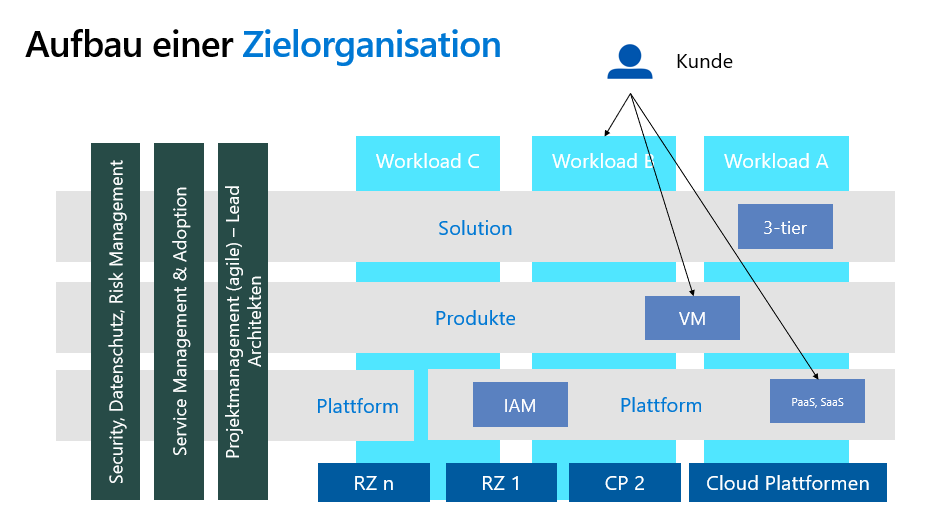
Adopting cloud technologies is more than a technical upgrade – it is an organizational paradigm shift. To successfully leverage the cloud, organizations must not only modernize infrastructure but also realign their own organization. This post explores why the shift from project-oriented to product-oriented structures is crucial – and how Microsoft’s Cloud Adoption Framework (CAF) supports this journey.
Why Organizations Need to Rethink
Traditional IT organizations are often structured in silos: infrastructure, development, operations – each unit works independently. Projects are individually planned, approved, and executed. This model reaches its limits in the cloud:
- Slow response times due to rigid processes
- High coordination effort between teams
- Low innovation speed
- Lack of end-to-end responsibility
Cloud demands agile, cross-functional teams that take ownership of products – from ideation to operations.
Key message: Cloud adoption is not an IT project, but an organizational project.
From Project to Product Organization
Microsoft distinguishes two models:
| Project-centric | Product-centric |
|---|---|
| One-time projects with fixed budget and timeline | Continuous development and operation of products |
| Resources assigned per project | Stable, cross-functional teams |
| Focus on delivery | Focus on value creation and user feedback |
| Annual planning | Iterative and incremental planning |
In a product-centric organization, permanent teams emerge that take responsibility for a product or service. They work iteratively, deliver value regularly, and can respond flexibly to new requirements.
The Cloud Center of Excellence (CCoE)
A central building block for transformation is the Cloud Center of Excellence. It helps to:
- Build a modern, agile IT organization
- Establish reusable, secure deployment packages
- Standardize cloud-native tools and processes
- Orchestrate collaboration between platform, product, and security teams
The CCoE is not a controlling body but an enabler for product-oriented work. It creates the conditions for autonomy without neglecting governance and security.
Cultural Change: From Control to Trust
Organizational change is inseparable from cultural change. Satya Nadella puts it aptly:
“As a culture, we’re moving from a group of people who know everything to a group of people who want to learn everything.”
Cloud demands a culture of responsibility, transparency, and continuous improvement. Teams must be empowered to act independently – with clear goals but without micromanagement.
Success Factors for Transformation
For organizational change to succeed, the following is needed:
- Executive Sponsoring: Leaders must actively support the transformation
- Product Ownership: Clear ownership structures for workloads and platforms
- Transparency: Visible backlogs, blockers, and progress
- Agile Processes: Iterative planning, regular reviews, and retrospectives
- Cross-functional Teams: Dev, Ops, Security, and Business working together
- Right Skills: Technical and organizational capabilities must be developed
“Shift the value of IT from Build, Own and Run to enabling others to act autonomously.”
Conclusion
Cloud is not just technology – it is a catalyst for organizational transformation. Those who take the change seriously create the foundation for more speed, innovation, and user-centricity. The Cloud Adoption Framework provides proven guidance for this journey.